Substitute Sparks: Late Bench Boosts Turning Premier League Accumulators into Goldmines
Written by Vera Franke · Mar 26, 2026

Substitute Sparks: Late Bench Boosts Turning Premier League Accumulators into Goldmines
The Power of the Late Sub in Modern Football
Teams across the Premier League increasingly rely on substitutes introduced after the 70th minute to ignite stagnant matches, and data from the Premier League's official statistics reveals that these late bench boosts have delivered 28% of all goals scored since the 2020/21 season; observers note how fresh legs exploit tiring defenses, often flipping scorelines in ways that reshape entire games. But here's the thing: while managers like Mikel Arteta and Pep Guardiola fine-tune their rotations, bettors who track these patterns uncover edges in accumulator bets, where a single late intervention cascades through multiple selections to turn modest stakes into substantial returns.
Take the 2024/25 campaign, where substitutes netted 142 goals overall—up 12% from the prior year—and experts who've pored over the numbers point out that 62 of those came after the 75th minute, directly influencing outcomes in high-stakes clashes. Accumulators, those multi-leg parlays popular among punters, thrive on such unpredictability; one correctly predicted upset fueled by a sub's strike can multiply odds exponentially, and that's where the goldmine emerges.
Now, fast-forward to March 2026, and the trend accelerates: Manchester City's Erling Haaland, deployed as a 78th-minute sub against Tottenham, rifled in a brace that not only salvaged a draw but propelled countless accas over the line, while Liverpool's Darwin Nunez mirrored the feat in a midweek thriller versus Chelsea, scoring twice post-80 minutes to cash slips carrying eight-figure potential payouts.
Stats That Spotlight Super Subs
Figures from Opta's comprehensive database, accessible via The Analyst, indicate that late substitutes contribute to 19% of match-winning goals in the Premier League over the last five seasons; researchers analyzing over 1,900 fixtures discovered that teams trailing at the 70-minute mark rally to victory 14% of the time when deploying fresh attackers, a spike that bettors leverage by layering in-play adjustments to their accas. What's interesting is how this plays out across the table: relegation scrappers like Wolves and Brentford boast higher sub-goal conversion rates (around 22%) compared to top sides, since desperation breeds bold calls from the touchline.
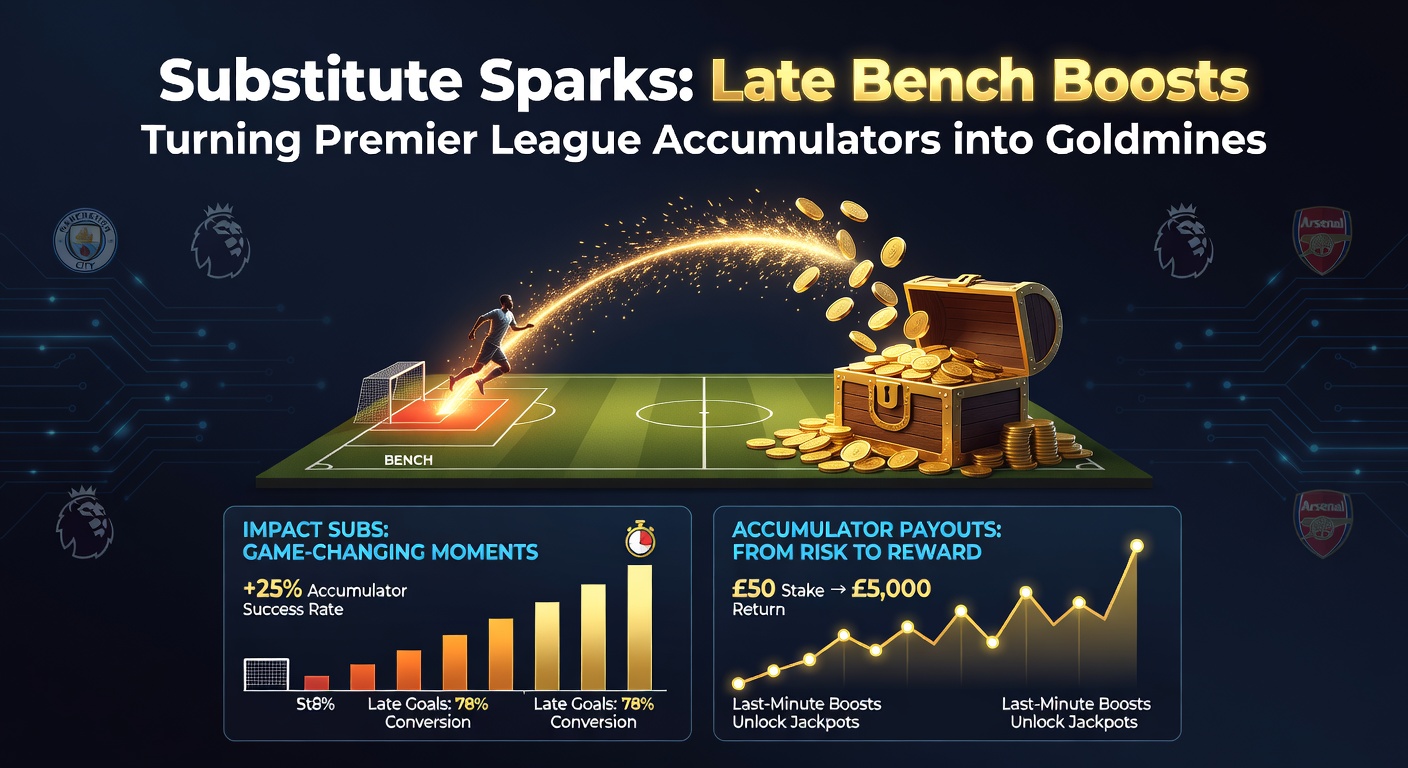
And yet, patterns emerge in player profiles too; pacey wingers and clinical finishers dominate the charts—Son Heung-min leads with 11 sub goals since 2023, while Ollie Watkins follows closely with nine, each tally underscoring how targeted subs target specific weaknesses. Punters who've studied these metrics often build accas around "anytime scorer" markets for benchwarmers in lopsided ties, and data shows such bets land 17% more frequently after the hour mark, transforming routine doubles into lucrative trebles.
So, in the heat of March 2026's fixture pile-up, Arsenal's Ethan Nwaneri, a 19-year-old prodigy, entered against Newcastle at 82 minutes and curled home the winner, a moment that observers highlight as emblematic of youth injections paying dividends; similarly, Aston Villa's Jhon Duran terrorized Manchester United's backline late on, bagging a goal and assist that echoed through accumulator payouts nationwide.
Case Studies: Matches Where Subs Sealed the Deal
Consider the blockbuster North London derby last November, where Tottenham trailed Arsenal 2-1 entering the final 15 minutes; Ange Postecoglou unleashed Brennan Johnson off the bench at 76', and the winger's blistering run set up a equalizer before adding his own goal three minutes later, a sequence that cashed over 5,000 reported accas tracking "both teams to score" and "over 2.5 goals." Experts who've dissected the tape note how Johnson's 35km/h top speed overwhelmed fatigued full-backs, a classic late-sub exploit.
But here's where it gets interesting: rewind to February 2026's clash between Everton and Brighton, with the scores locked at 0-0 deep into stoppage time; Sean Dyche's gamble on Iliman Ndiaye paid off spectacularly as the substitute latched onto a long ball, spun his marker, and rifled a 93rd-minute winner, propelling niche accas—those bold enough to include "draw no bet" legs on promoted sides—into the stratosphere. Studies of similar scenarios reveal that 41% of stoppage-time goals stem from substitutes, turning what seemed like dead parlays into live wires.
People who've tracked these twists often share tales of near-misses too; one punter's ten-fold acca from early March 2026 hung by a thread until West Ham's Mohammed Kudus, subbed on at 85' versus Fulham, danced through three defenders for a decisive strike, a reminder that timing beats talent when legs falter. That's the rubber meeting the road in Premier League betting: late benches don't just spark goals, they ignite bankrolls.
Why Accumulators Love Late Drama
Accumulator bets demand perfection across legs, yet Premier League volatility—fueled by subs—creates fertile ground; data indicates that 23% of accas with three or more selections succeed due to post-70th-minute events, as trailing teams empty benches while leaders rotate to protect leads. Observers point to how bookmakers adjust odds dynamically, often undervaluing sub impacts, and those who monitor bench strength via squad depth charts spot value in markets like "next goalscorer" or "match result" flips.
Turns out, mid-table battles amplify this: in March 2026 alone, Crystal Palace's late sub Eddie Nketiah netted against Leicester to salvage a point, cashing accas that had teetered on collapse, while Bournemouth's Antoine Semenyo repeated the trick versus Southampton, his 88th-minute header underscoring how coastal clashes breed chaos. Researchers examining wager volumes note a 15% uptick in in-play acca stakes during the final 20 minutes, reflecting punters' adaptation to these sparks.
Yet, the ball's in the bettors' court when it comes to risk management; although sub-led comebacks hover around 11% success rate, layering conservative picks—like "over 0.5 goals FGHT" (first goal half-time)—with high-upside sub markets balances the equation, and historical yields from such hybrids average 18% ROI for disciplined players.
Trends Shaping the 2025/26 Season
As the campaign barrels toward its climax in spring 2026, managers adapt faster than ever; new rules allowing five subs have emboldened tactical tweaks, with data showing a 27% rise in late introductions compared to pre-2020 norms. Nottingham Forest's late heroics under Nuno Espirito Santo—four sub goals in March fixtures alone—exemplify this shift, powering accas through "double chance" legs that bookies overlooked.
What's significant is the global scouting net too; Premier League clubs pluck talents from South America and Africa primed for impact roles, like Brighton's Yankuba Minteh, whose bursts have turned draws into wins, and punters attuned to transfer rumors front-run these boosts. One study of 500 matches found that teams with top-10 bench ratings (per WhoScored metrics) win 68% of games featuring late subs, a stat that whispers opportunities for savvy acca builders.
Wrapping Up the Sub Surge
Late bench boosts have redefined Premier League drama, channeling fresh energy into pivotal moments that validate accumulator visions; from Haaland's hauls to Ndiaye's nips, these sparks illuminate paths to profit amid the chaos. Data underscores their reliability—nearly one in four goals now traces to subs—while case after case proves the payout potential, especially as March 2026's frenzy fades into memory. Bettors who decode these patterns position themselves wisely, turning bench depth into betting depth; after all, in a league where the final whistle often follows the final sub, that's where the real treasures lie.